
The Numbers Don’t Lie: How Care Management Actually Improves ROI and Chronic Disease Outcomes
Introduction
Common Scenario
Nine days after her discharge for heart failure, a patient is home — mostly taking her new medications, weighing herself some mornings and not others. Nobody on her care team knows either fact. Her next appointment is five weeks out, and by the time it arrives she is back in the emergency department, several pounds heavier than the day she left the hospital, short of breath, wondering what she did wrong.
In Between Visits
She did nothing wrong. The system simply wasn’t built to notice her in the space between visits — and that space is where a striking share of the nation’s healthcare spending quietly accumulates. The Centers for Disease Control and Prevention (CDC) puts a number on it: 90% of the nation’s $5.3 trillion in annual healthcare spending goes toward people living with chronic and mental health conditions.[1] Most of that spending doesn’t happen in a hospital bed. It happens in the fifteen-minute visit every few months, and everything that goes unwatched in between.
Closing the Gap
Medicare has spent the last decade building an answer to that gap: three programs that pay clinicians to manage patients continuously rather than episodically. Remote Patient Monitoring puts a connected device — a blood pressure cuff, a scale, a glucose meter — into a patient’s home and a live data stream in front of a care team. Chronic Care Management pays for the phone calls, medication reviews, and coordination that happen between visits for anyone juggling two or more chronic conditions, which describes roughly two-thirds of the Medicare population.[2] Principal Care Management does something narrower: it pays for that same kind of attention when one serious condition, not two or three, is doing all the damage.
All three of care management promise a version of the same thing: catch the problem before it becomes a hospitalization. What follows is program by program, the actual evidence behind that promise — where it holds up, where it’s modest, and where, honestly, it doesn’t exist yet.
Remote Patient Monitoring
Tested, Not Just Widely Implemented
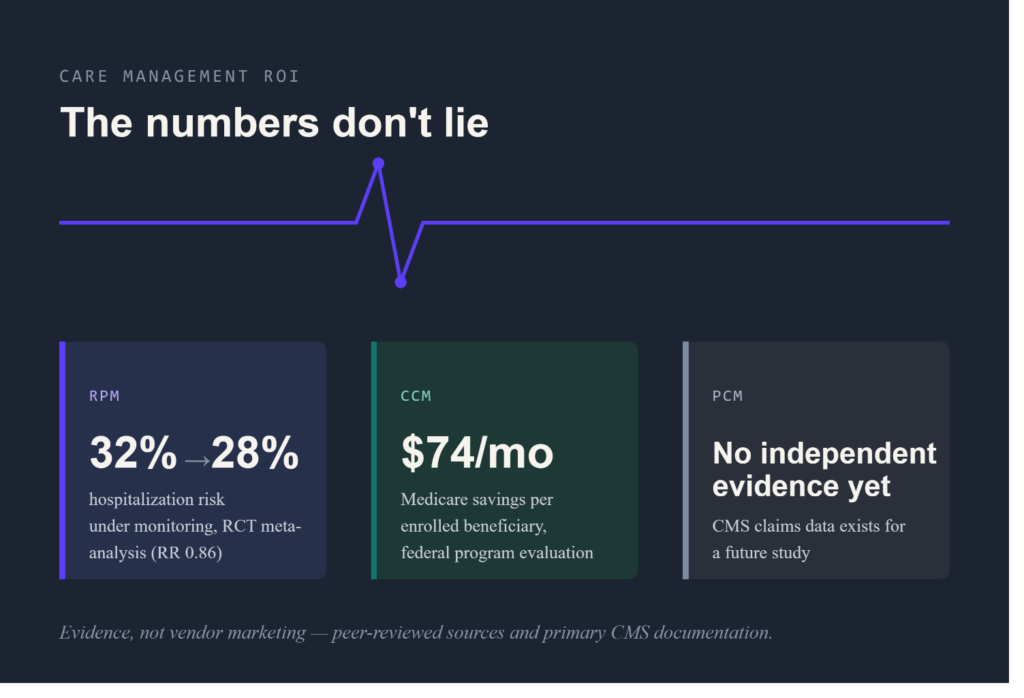
Of the three programs in this paper, RPM is the one with an actual paper trail of randomized trials behind it — the closest thing health policy has to a receipt. The most rigorous version of that receipt is a 2025 analysis in JMIR mHealth and uHealth that pooled 40 randomized controlled trials, more than 11,600 patients in total, spanning heart disease, COPD, cancer, and diabetes.[3]
That’s a real but modest effect — not the dramatic transformation vendors like to promise, and the researchers themselves rated the certainty of that pooled number as low, given how differently the 40 trials were designed. The effect gets considerably stronger, though, in the population RPM has been studied the most: cardiovascular disease, where hospitalization risk dropped by roughly a quarter.[3] Stays that did happen were shorter too, by about three-quarters of a day on average.[3]
What RPM didn’t do is just as telling. Emergency department visits barely moved. Outpatient visits didn’t drop at all — if anything, they ticked up slightly.[3] So, RPM isn’t making people need care less. It’s making the care they get more targeted — catching a problem in a phone call instead of a hospital bed.
RPM isn’t making people need less care. It’s making the care they get more targeted.
That gap between the promise and the modest reality comes down almost entirely to execution. Researchers who study why some RPM programs work and others don’t point to the same handful of failure points, over and over: alerts that sit unanswered, patients who quietly stop wearing the device, data that never makes it into a clinician’s actual workflow.[4] The technology is rarely the problem. What happens after the data arrives is.
The Clearest Example: A Medication Chart
The clearest illustration of RPM working as intended isn’t a hospitalization statistic — it’s a medication chart. Heart failure patients are supposed to reach specific target doses of guideline-recommended drugs, a process called titration that normally takes months of in-person dose adjustments. Researchers tested what happens when that process moves to a remote, monitored track instead. The results were stark.
Patients on the remote track reached target doses faster, and needed fewer clinic visits to get there — 1.6 in-person visits on average instead of 2.4.[5] That better dosing wasn’t just a paperwork win, either: patients in the remote-titration group were hospitalized 45% less often than those managed the usual way[5] — a direct, mechanistic line from “we adjusted the medication faster” to “they stayed out of the hospital,” which is a rarer thing to find in this literature than you’d expect.
Patients seem to feel the difference, too. In a Mayo Clinic survey of more than 3,100 people enrolled in RPM programs, 94% said they were satisfied and felt ready to graduate once their goals were met, and 93% said they’d recommend it to someone in a similar situation.[6]
None of this is evenly distributed yet. Hospitals serving lower-income communities are measurably less likely to have adopted RPM in the first place,[7] and rural programs run into their own wall of spotty connectivity, lower digital literacy, and thin staffing.[8] The evidence says RPM works. It doesn’t yet say it works everywhere.
Chronic Care Management
Proven, and Barely Used
If RPM’s evidence lives in trial data, CCM’s lives in something almost as convincing: nearly a decade of Medicare’s own bookkeeping. When CMS started paying for CCM in 2015, it commissioned an independent evaluation to see whether the money was actually working. And it was: enrolled beneficiaries cost Medicare about $74 less per month — roughly $888 a year — driven mostly by fewer hospitalizations and emergency visits.[9]
That’s a meaningfully smaller number than the 200–400% ROI claims that circulate in vendor marketing for this program — and it’s measuring something different besides: savings to Medicare, not a practice’s return on the staff time CCM costs to deliver. A separate study modeling that side of the equation found practices genuinely can come out ahead over a ten-year horizon, but the size of the win depends heavily on who’s doing the work: practices that hand CCM delivery to nurses and care coordinators, rather than physicians, come out meaningfully further ahead.[10]
The program appears to genuinely work. Most of the patients it was built for have never used it.
The Part That Doesn’t Make the Pitch Deck
Roughly two-thirds of Medicare beneficiaries have two or more chronic conditions and qualify for CCM.[2] In the program’s first year, only 1.1% of them actually received it. By 2019, that had crept up to 3.4%.[11]
Coverage has kept climbing since — enrollment has grown by roughly 7% a year since 2019, reaching 1.3 million beneficiaries in 2023[2] — but the program is still reaching a small fraction of the population it was built for. There’s a second wrinkle worth naming plainly, too: a 2023 review of CCM claims found that only 77% of them documented the two-or-more qualifying conditions the program requires; 18% listed just one condition, and 5% listed none at all.[2] That’s not evidence of bad care. It’s evidence that the paperwork hasn’t fully caught up to the program — worth watching as CCM keeps scaling.
Principal Care Management
An Honest Gap
PCM is the youngest of the three programs, created in 2020 for a gap CCM doesn’t cover: patients whose care needs come from one serious condition — advanced heart failure, uncontrolled diabetes, severe COPD — rather than two or three at once. Structurally, it looks like a smaller, more focused version of CCM: at least 30 minutes of dedicated clinical staff time each month, billed under its own set of codes.[12]
As of this writing, no independent, peer-reviewed study has measured PCM’s effect on hospitalizations, cost, or outcomes. Given how closely it mirrors CCM’s logic, a similar effect is a reasonable expectation — not a documented finding. This paper won’t manufacture one to fill the gap.
That gap is closable, and it will probably close soon. Medicare’s own claims data already captures PCM billing under its dedicated codes — the same raw material that eventually produced CCM’s evidence base. The missing ingredient isn’t methodology; it’s volume. Enough beneficiaries, enrolled long enough, for the numbers to say something with confidence. Until then, anyone citing a specific ROI figure for PCM is citing something nobody has actually measured.
Three Programs, Three Stages
Line the three programs up and a pattern emerges — not one program beating the others, but three different points on the same evidentiary journey.
40 randomized trials. A modest, real reduction in hospitalization risk — strongest in cardiovascular disease. Works only as well as the team responding to the data.
A decade of Medicare’s own data says it saves money and cuts hospitalizations. Fewer than 4 in 100 eligible patients have ever actually received it.
A sound idea built on CCM’s own logic, with no independent outcomes study yet to confirm it. The infrastructure to measure it already exists.
The thread connecting all three: none of them deliver a return automatically. Reimbursement, technology, and even strong trial evidence only set the stage. What determines whether or not a program pays off — clinically or financially — is what a health system does after the billing code is turned on.
Consistent monitoring and regular touchpoints are key success factors.
Five Field Notes
- 01Staff it with nurses, not physicians.
CCM’s financial return depends more on who delivers the care than on the billing code itself — nonphysician-led delivery consistently comes out ahead.[10]
- 02Chase the right patients, not the easy ones.
RPM’s strongest evidence is concentrated in cardiovascular disease. Broad, untargeted enrollment dilutes the effect you can actually expect.[3]
- 03Answer the alert.
The single biggest predictor of a failed RPM program isn’t the device — it’s data nobody responds to in time.[4]
- 04Document like someone is checking.
Nearly a quarter of 2023 CCM claims didn’t fully document eligibility. Someone is checking.[2]
- 05Don’t promise what PCM hasn’t proven.
Build the program on its clinical logic, not on a borrowed statistic from a program it merely resembles.
Going back to the patient
Going back to the patient scenario nine days after her discharge…
Nothing in this paper promises she never sees the inside of an emergency department again. What the evidence empirically supports is narrower, and more honest: her odds get better — modestly, unevenly, and only where someone built the program to notice her in time.
What DiaSante Offers
DiaSante is a technology-based RPM, CCM, and PCM solutions provider collaborating with hospital systems, private clinicians, and other healthcare organizations to successfully implement and scale chronic disease management programs, aiming to boost your numbers.
Contact us to see how we can increase your ROI, improve patient outcomes, and enhance overall patient satisfaction.
Let’s grow together.
Contact DiaSanteSources
A note on sources: Every statistic herein comes from a peer-reviewed journal or a primary CMS evaluation, not vendor marketing. Where that evidence doesn’t exist yet, we say so rather than filling the gap.
- Fast Facts: Health and Economic Costs of Chronic Conditions — Centers for Disease Control and Prevention. cdc.gov/chronic-disease/data-research/facts-stats
- Chronic Care Management in Medicare: Optimizing Utilization — Avalere Health Advisory, Medicare fee-for-service claims analysis.
- Smedslund G, Østerås N, Hestevik CH. Effects of Remote Patient Monitoring on Health Care Utilization in Patients With Noncommunicable Diseases: Systematic Review and Meta-Analysis. JMIR mHealth and uHealth. 2025;13:e68464.
- Thomas EE, Taylor ML, Banbury A, et al. Factors influencing the effectiveness of remote patient monitoring interventions: a realist review. BMJ Open. 2021;11(8):e051844.
- Ginsburg L, Ross HJ, Van Spall HGC, et al. The Effect of Using a Remote Patient Management Platform in Optimizing Guideline-Directed Medical Therapy in Heart Failure Patients: A Randomized Controlled Trial. Journal of Cardiac Failure. 2024.
- Patient Satisfaction With a Multisite, Multiregional Remote Patient Monitoring Program for Acute and Chronic Condition Management: Survey-Based Analysis. PMC.
- Socioeconomic Determinants of Remote Patient Monitoring Implementation Among Rural and Urban Hospitals. PMC.
- Challenges for remote patient monitoring programs in rural and regional areas: a qualitative study. BMC Health Services Research. 2025.
- Evaluation of the Diffusion and Impact of the Chronic Care Management (CCM) Services — Final Evaluation Report, prepared for CMS.
- Basu S, Landon BE, Song Z, et al. Medicare Chronic Care Management Payments and Financial Returns to Primary Care Practices: A Modeling Study. Annals of Internal Medicine. 2015;163(8):580–588.
- Use of Chronic Care Management Service among Medicare Beneficiaries in 2015–2019. PMC.
- Principal Care Management — Care Management Reimbursement, Rural Health Information Hub.